Wednesday, October 3, 2018

North Platte Nebraska, Bailey Railroad Switching Yard - Excelsior Springs, Missouri, Watkins Mill State Park

Since our last post we have moved to Cody Park in North Platte, Nebraska, home to Bailey Yard, the world’s largest railroad classification yard. Personnel there sort, service and repair locomotives and cars headed all across North America.  We then moved on to Conestoga Lake State Park in Denton, Nebraska.  From their we moved to our present location, Watkins Woolen Mill State Park, home of the only completely original 1860's woolen mill in the country.  Watkins Woolen Mill State Park is located near Excelsior Springs, Missouri about 30 miles northeast of Kansas City.

Our Route

Cody Park in North Platte, NE was quite an interesting campground.  The park, located right on the North Platte River included a zoo right next to the campground, ball fields, playgrounds, an amusement park with carnival type rides and a train museum.  North Platte is a major railroad hub which provides much of the employment in the city so a lot of the attractions are railroad themed.

Buffalo At The Zoo

One lonely elk

This is Golden Spike Tower - the name is a reference to where the Union Pacific and Central Pacific Railroads met  when building their railroad across the West (nothing to do with the Promontory Point,Utah Golden Spike where the East and West Transcontinental Railroads met)


View of the Bailey Yard from the tower - photos don't capture the immensity of the yard - it overs 2850 acres and is eight miles long.  The yard and all the train car sorting is controlled by computer - it is quite amazing to watch the individual cars being routed to the proper train utilizing gravity and computer speed control.  Around 14,000 cars pass through the yard each day and they sort around 3000 cars a day.  The yard has about 200 sets of tracks covering 315 miles if laid end to end.


This is the only train of this class in existence in the world - it is enormous - these photos are from the Cody Park Railroad Museum where we were staying.


The museum was mostly in the train but there were a few exhibits in the train station.

Donna in the engineer's seat on old 3877


Part of he museum inside the train

This car was a US Post Office car used for sorting mail - I assume for railroad employees

The exterior of the postal service car

Old 3977 and its tender

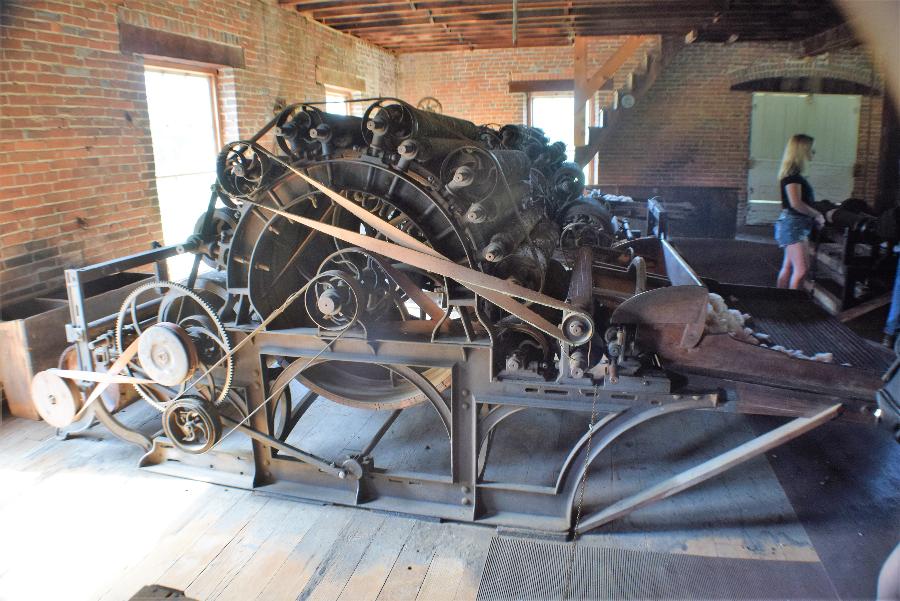
The following photos are from Watkins Woolen Mill State Park in Excelsior Springs, Missouri.  Watkins Woolen Mill is said to be the only completely original woolen mill from the mid 1800's that is still completely intact including all of its original machinery.  Most mills were either vandalized or the machines were salvaged for scrap to support the war effort during World War II.  It is believed  the remote location of the mill allowed it to survive intact.  The mill closed in 1898 and is pretty much the way it was when the doors closed.

The Visitor Center

Home of Waltus L. Watkins who built the mill.  We took a tour of the house and it too is much the way it was in the 1800's including much of the original furniture.

The summer kitchen (separate building)

The mill - just down from the house

The steam engine that ran the mill - this engine was salvaged by Watkins from a sunken steamboat on the Missouri River and powered the mill from 1860 to 1898

Views inside the mill - most everything is as it was in 1898



Our tour guide - bobbins of thread are new for demonstration purposes

Many of the employees signed this wall in 1898 when they were notified of the mill closing

This was the retail store where they sold yarn, blankets and fabric produced in the mill as well as flour and related products (Watkins also had a grist mill next to the woolen mill )

Saturday, September 22, 2018

Fort Robinson, Nebraska - Toadstool Geologic Park

We are now in Northwest Nebraska at Fort Robinson State Park near Crawford, NE.   The Fort played a prominent role in the Indian Wars of 1876-1890 and was also a  prisoner of war camp for German POW's in WWII.
Our Route

Our Site


Post headquarters which houses an interesting museum containing many artifacts from the fort's early days.

Recreations Oon the original site)  of the early barracks, adjutants office and prison buildings

Crazy Horse was killed next to the prison building when he resisted being placed in confinement

The spot where Crazy Horse was killed and the recreation of the prison building 

The original veterinary hospital

Horse stalls in the hospital

Operating room with original horse table

Originally the Army theater building, this building now houses the Trailside Museum of Natural History which has an impressive collection of early fossils from the surrounding area

Mammoth - about 80% original - this mammoth was one of the two that were discovered with their tusks locked - the skull is a recreation as the original skull is in the display with the two mammoths with locked tusks (see next pic)

Duel to the death display - two giant mammoths locked tusks about 10,000 years ago and were not able to separate or rise - this is the only pair of locked tusk mammoths ever found in the world - both skeletons were mostly intact 

Ancient rhinoceros skeleton discovered nearby

Original horse barns

The rest of these pics are from the Toadstool Geological Park, not far from the fort

A reconstructed early settler's "Soddy" sod house 

Inside view - walls are nearly 3 feet thick

Toadstool Geological park was named for the many large chunks of sandstone balanced on volcanic ash pillars - many of these have fallen since the park was named

Typical landsape here


30 million year old rhinoceros tracks in an exposed riverbed - there is about 3/4 of a mile of this riverbed that is exposed

More tracks - mostly rhinoceros and entelodont (giant wild pig) tracks

Monday, September 17, 2018

Grand Teton National Park, Jackson, WY, Jackson Hole

We left Yellowstone and spent four days at  Gros Ventre Campground which is in Grand Teton National Park.  After our time at Grand Teton, we spent one night at Wind River Casino (free overnight for RVers) and then moved on to Platte River RV and Campground in Glenrock, Wyoming.  We will be here for 6 days.  We had to stop here to get Darby's four week after surgery x-ray of his leg which will be done at a vet in Douglas, WY.  We decided to stop here because once we get past Douglas we weren't sure if there would be any towns large enough in Northwest Nebraska to have a vet that did digital imaging to allow the X-ray to be emailed back to the surgeon in Bend, Oregon.  From here we will be headed to Fort Robinson in Crawford, Nebraska.

Our Route

View of The Tetons from our campsite 

The following two pics are of two of the most photographed barns in America.  They are located about a mile from the campground in an area known as "Mormon's Row" which was a settlement of five Mormon families in the 1880's.  Several of the homes and barns are still standing.

This barn is the more famous of the two

Teton Glacier

Donna in the window of a settler's cabin from the 1800's

More Buffalo - Tetons in the background

View of the Snake River and the Tetons

Part Of Jackson Lake

Donna at the Grand Teton visitor center

One of a pair of moose at the campground

Both of them

Donna too close to the moose

The same guy

Jackson, Wyoming - The rest of the pictures are of Jackson, Wyoming.  Jackson is the town nearest the Tetons and Jackson Hole is the general area which is mainly the 50 mile long valley that includes Jackson and several other small towns.

Jackson has a park in the center of town that has amazing huge elk antler arches on each of the four sides of the park.  There is a nearby National Elk Refuge where the antlers were collected.  Each spring, Boy Scouts collect shed antlers and have an auction (at this park) to raise money for the winter feeding of the elk at the refuge - this has been going on for 50 years. .

Close-up

One set of moose antlers on each arch

 Another one of the arches

View of downtown Jackson

Another view of Jackson